
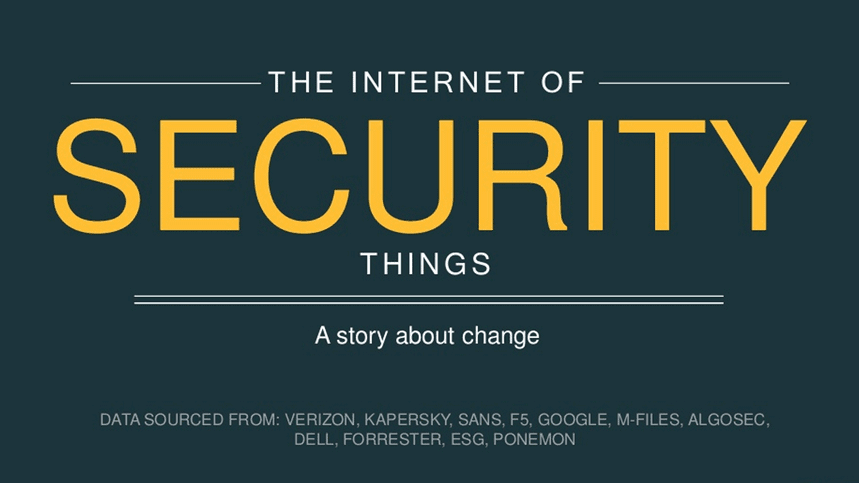
No, this isn't a tirade on the security of IoT. It's about story about change. Specifically, change and its implications on security.
Change is constant. There's a million different axioms and proverbs about change, so it's really hard to choose just one to sum up how it impacts security. Inarguably it does. And right now there's a lot of change going on that's impacting security.
"Micro" movement like microservices and microsegmentation are dramatically changing perimeters and breaking apart traditional "edge" security into distributed pockets of security, each architected specifically for the application or architecture it's protecting.
The nearly ubiquitous use of HTTP as the de facto application transport protocol (it's the new TCP, you know) has led to an increasing rise in the elimination of network access and an increase focus on application access, as well as more attention being paid to the security dangers inherent in the application layer.
The rise of connected things both internal and external to the data center are of course a concern; putting pressure on networking and security operations alike to adjust in rapid fashion to an increasingly complex array of connections, applications, devices, people and data.
And of course attacks are on the rise, with the DPS of a DDoS having doubled in just the past few years.
These are all changes. Some good, some bad, some inherently neutral, but all impacting security in one way or another.
Out of these interconnected and interrelated trends comes four key areas of concern: web application security, scale and capabilities of access and identity management, operationalization and DDoS protection mechanisms.
The Internet of Security Things is a quick look at change across all four of these areas and what we can do to start addressing them.
About the Author

Related Blog Posts
Why sub-optimal application delivery architecture costs more than you think
Discover the hidden performance, security, and operational costs of sub‑optimal application delivery—and how modern architectures address them.

Keyfactor + F5: Integrating digital trust in the F5 platform
By integrating digital trust solutions into F5 ADSP, Keyfactor and F5 redefine how organizations protect and deliver digital services at enterprise scale.

Architecting for AI: Secure, scalable, multicloud
Operationalize AI-era multicloud with F5 and Equinix. Explore scalable solutions for secure data flows, uniform policies, and governance across dynamic cloud environments.
Nutanix and F5 expand successful partnership to Kubernetes
Nutanix and F5 have a shared vision of simplifying IT management. The two are joining forces for a Kubernetes service that is backed by F5 NGINX Plus.
AppViewX + F5: Automating and orchestrating app delivery
As an F5 ADSP Select partner, AppViewX works with F5 to deliver a centralized orchestration solution to manage app services across distributed environments.

F5 NGINX Gateway Fabric is a certified solution for Red Hat OpenShift
F5 collaborates with Red Hat to deliver a solution that combines the high-performance app delivery of F5 NGINX with Red Hat OpenShift’s enterprise Kubernetes capabilities.