Delivering secure, always-on data for connected vehicles
The connected vehicle ecosystem contains apps, APIs, data, and cloud‑to‑edge systems spanning across hybrid multicloud environments to enable real‑time response and automation. F5 ADSP unifies delivery and security across these environments, protecting vehicle data while ensuring secure, high‑performance connectivity and consistent policy enforcement as vehicles become software‑ and AI‑driven.
Autonomous vehicles depend on real-time, trusted telemetry
Autonomous and connected vehicles are fundamentally distributed systems. Each vehicle continuously produces high-volume, high-velocity telemetry from sensors, cameras, control systems, and onboard software that must be ingested, routed, and acted on in real time. This telemetry increasingly feeds not only monitoring and maintenance workflows, but also vehicle-to-vehicle (V2V) and vehicle-to-infrastructure (V2I) interactions, where latency, correctness, and trust directly affect safety and system behavior. Message Queuing Telemetry Transport (MQTT) has emerged as a common protocol for this architecture due to its lightweight publish/subscribe model and suitability for unreliable networks at scale.
At production scale, vehicle telemetry behaves like a mission-critical application, not a best-effort data stream. The MQTT control plane and broker infrastructure must deliver continuous availability, elastic scalability, deterministic routing, and strong security under a bursty, unpredictable load. Failures are not isolated to individual vehicles; MQTT infrastructure outages, degraded routing, or compromised data paths can cascade across fleets, erode system confidence, and introduce real-world risk. Architects must design for zero-downtime operation, disaster recovery, and consistent policy enforcement across cloud, edge, and on-premises environments.
“At production scale, vehicle telemetry behaves like a mission-critical application, not a best-effort data stream.”
As telemetry volumes grow and AI systems are layered into analysis and decision-making, the architecture becomes even more constrained. AI pipelines require low-latency, high-integrity data flows and controlled access to prevent data exfiltration, model misuse, or out-of-scope queries. Without a unified application delivery and security layer, teams are forced to stitch together point solutions that increase operational complexity and create blind spots. A platform-based approach is essential to reliably deliver, protect, and scale vehicle telemetry and AI workloads as a single, coherent system.
Always-on data delivery and security for vehicle telemetry
Connected vehicle architectures require a unified application delivery and security service that treats telemetry as a mission-critical workload. Rather than trying to embed availability, routing, and security logic into the MQTT API, telemetry IT architectures benefit from centralizing these concerns in the data plane. This approach decouples control and protection from application logic, enabling consistent behavior across cloud, edge, and on-premises environments while simplifying operational ownership.
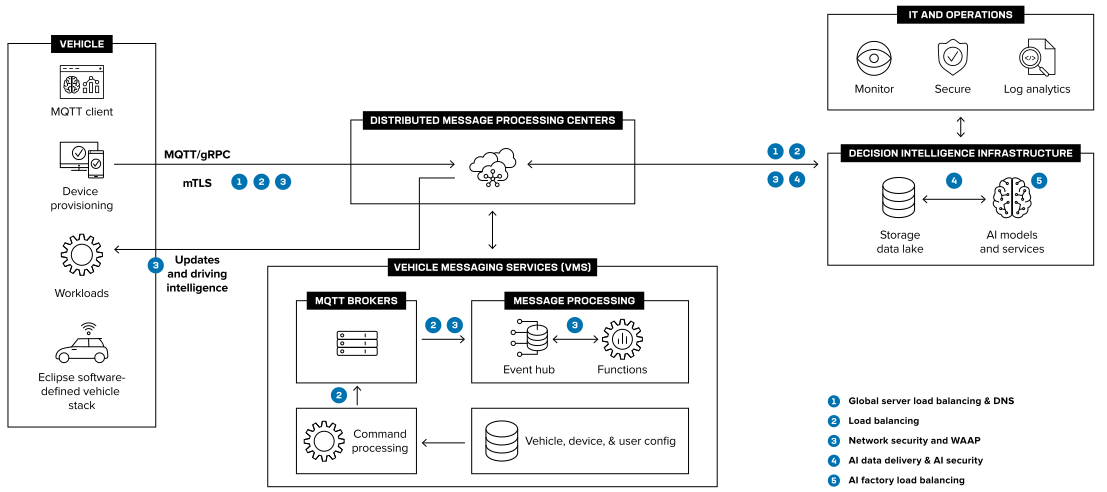
At the infrastructure layer, intelligent traffic management ensures telemetry is always routed to healthy, optimal MQTT brokers based on real-time conditions such as latency, capacity, and availability. Intelligent DNS and application delivery services provide elastic scale, seamless failover, and zero-downtime operations as fleets grow and traffic patterns fluctuate. Inline security and encryption enforce trust across vehicle-to-cloud communications, inspecting payloads and APIs to prevent tampering, unauthorized access, or data exfiltration—without introducing latency that would compromise real-time use cases.
As AI systems are used to generate value from the large volumes of telemetry data, it is essential to enforce performance and security boundaries for AI data flows and inference requests. Optimized delivery makes certain low-latency access to real-time data, while policy controls limit queries, agents, and model interactions to approved scopes. By unifying telemetry delivery, AI enablement, and security enforcement within a single platform, organizations reduce architectural complexity, eliminate blind spots, and gain the operational consistency required to safely scale autonomous and connected vehicle systems.
Connected vehicles demand platform-grade delivery and security
Connected and autonomous vehicles operate as large-scale, distributed application environments where telemetry, APIs, and AI systems must perform reliably under changing conditions. As vehicles become increasingly software-defined, the infrastructure that delivers and protects these data flows becomes inseparable from the vehicle itself. Autonomous mobility is a data challenge as much as a vehicle engineering challenge, and the supporting IT infrastructure must be architected with consistent and reliable rigor, resilience, and safety guarantees.
“Autonomous mobility is a data challenge as much as a vehicle engineering challenge.”
The F5 Application Delivery and Security Platform (ADSP) provides a unified approach to traffic management, security enforcement, and operational visibility for connected vehicle ecosystems. By centralizing data delivery and protection, F5 enables architects to simplify design, reduce failure, and enforce a consistent policy across multicloud and edge environments. The result is an infrastructure that supports always-on MQTT telemetry, secure AI integration, and predictable performance as vehicle fleets and software complexity continue to grow.