- Security is important, but so is performance.
- More than half (57%) of organizations use web application firewalls to protect apps in the cloud and on-premises (State of Application Delivery 2018)
- Scanning an outbound response is one of the last opportunities to detect a breach in progress – and stop it.
- You can have “too much of a good thing.” Carefully consider how to balance security with performance to optimize both.
We (as in everyone) know how important performance is to the continued success of the digital business. While those of us who were weaned on dial-up connections and hours-long downloads are tend to be more forgiving when it comes to performance, our digital native children are not so generous. They expect instantaneous responses and quick downloads.
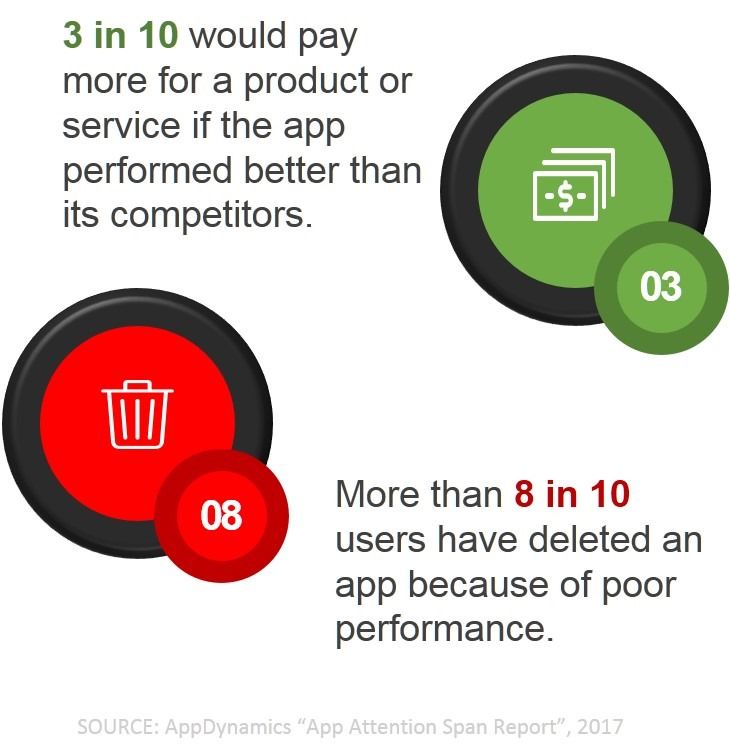
The proof of our impatience is in the numbers – more than 80% of us have deleted an application because of poor performance. Some of us – three in ten – are even willing to pay for the privilege of our apps being lightning fast.
But we’re hard to please, no matter what technology generation we’re from. Don’t you dare ignore security while you’re making that app go faster. If you do, and our data is breached, we’ll do more than just delete your app.
It is left, then, to IT professionals – particularly those who practice security – to balance the demand for performance with the need for security. Apps must be fast and secure.
One of the ways more than half of organizations achieve safer apps is by using a web application firewall (WAF) – amongst other application services – to protect applications against attack. They do this in two ways:
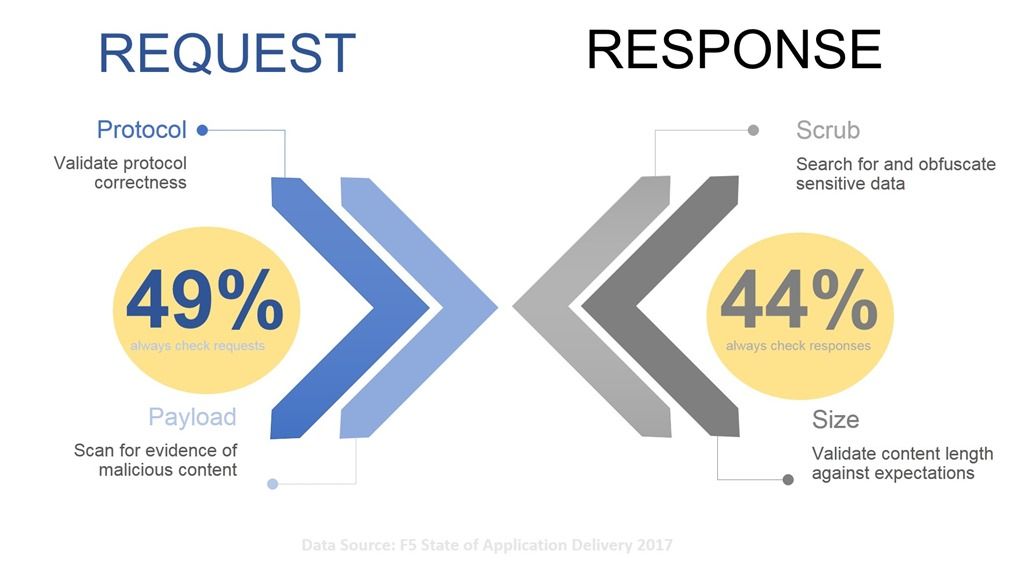
First, they scan inbound requests to detect any malicious activity. Second, they inspect outbound responses. It is no surprise that organizations that always apply these security tactics are amongst those with the highest confidence in withstanding an application attack.
Using a WAF you can inspect every last bit of a request and a response. You can parse, pull apart, twist, and modify content however you want.
But just because you can, doesn’t mean you should.
Security is not free. It takes CPU cycles and memory to inspect application traffic with the kind of attention required to find attacks or evidence of a breach.
That’s why it’s important to balance security with performance. Every extra microsecond you spend scanning or scrubbing is an extra microsecond users must wait for that response.
And they add up.
After all, it’s a matter of physics that it takes a number of microseconds for packets to pass through a network and back. It takes another few microseconds to establish a connection. Another few to process… you get the picture. Everything you do takes time, and the more time you take, the more impatient your users are growing.
Some have traditionally thrown the baby out with the bathwater when it comes to this conflict. They turn off security until performance is acceptable. But that’s not the right answer. There is a balance that can satisfy both the need for security and the demand for performance.
On the request, feel free to perform protocol-level parsing and verification. Inspect the payload and seek out any signs of an attack. Go with signature based scans first and text-based comparisons second. Signature-based scans when possible improve the performance of security because you don’t have to parse and compare. It’s just a straight comparison, and it’s a pretty fast process.
On the response, don’t succumb to the temptation to parse and put the content under a microscope. There has to be some level of trust with developers, here, that the JSON is formatted correctly or the XML follows the appropriate schema. Face it, if there’s a protocol or format error here, the user will find out about it. That’s a developer concern, it’s not generally a security risk.
What is a security risk is the inclusion of sensitive data – credit card or account numbers, social security numbers, e-mail addresses, perhaps. Numbers and data with well-defined patterns that can be quickly scanned for and obscured in the data. Like signature-based scans, you’re doing pattern matching here and security services have gotten really good at performing them as fast as they can.
Content length, too, is something you’ll want to check if you can. A number of high-profile exploits were identifiable simply by the amount of content returned. If you know a specific request should only return about 1K of data, then a 4K response should probably set of alarm bells somewhere. It’s a simple check that takes far less time than parsing and counting data records.
A good rule of thumb is to always obey Security Rule Zero on the request and check everything you can when there is user input present. On the outbound, look for indicators of an ongoing breach and obfuscate sensitive data, but don’t spend time worrying about data formats and schema compliance. Let developers worry about whether they formatted the response correctly. That is their purview, not yours.
Security and performance can be balanced, as long as you don’t sacrifice one for the other. And that means in both directions. Don’t give up security for performance, but don’t throw performance under the bus for the sake of (potentially unnecessary) security.
If you use security strategically to prevent exploitation and detect breaches you can achieve the balance with performance you need to keep users happy and data and applications safe.
About the Author

Lori MacVittie is a Distinguished Engineer and Chief Evangelist in F5’s Office of the CTO with deep expertise in application delivery, automation strategy, and infrastructure. She is known for turning complexity into clarity whether she’s defining guardrails for AI agents, dissecting brittle multicloud architectures, or probing the limits of scalable systems. She brings more than thirty years of industry experience across application development, IT architecture, and network and systems operations. Before joining F5, she served as an award-winning technology editor. MacVittie holds an M.S. in Computer Science and is a prolific author whose publications span security, cloud, and enterprise architecture. She is also an avid tabletop and video gamer with unapologetically strong opinions about cheese.
More blogs by Lori Mac VittieRelated Blog Posts

A new path to technical excellence for F5 partners
Introducing F5 Partner Foundations, a structured learning curriculum to build F5 partner engineer expertise with a clear pathway to specialization.

Secure-by-design storage for agentic AI: Why runtime visibility plus traffic control matters
Learn how F5 is collaborating with NVIDIA to help protect agentic AI with secure-by-design AI infrastructure, runtime visibility, and traffic control.

Why sub-optimal application delivery architecture costs more than you think
Discover the hidden performance, security, and operational costs of sub‑optimal application delivery—and how modern architectures address them.

Architecting for AI: Secure, scalable, multicloud
Operationalize AI-era multicloud with F5 and Equinix. Explore scalable solutions for secure data flows, uniform policies, and governance across dynamic cloud environments.

AppViewX + F5: Automating and orchestrating app delivery
As an F5 ADSP Select partner, AppViewX works with F5 to deliver a centralized orchestration solution to manage app services across distributed environments.

F5 NGINX Gateway Fabric is a certified solution for Red Hat OpenShift
F5 collaborates with Red Hat to deliver a solution that combines the high-performance app delivery of F5 NGINX with Red Hat OpenShift’s enterprise Kubernetes capabilities.